Signed in as:
filler@godaddy.com
The best STEM books for kids combine engaging storytelling, strong visuals, and hands-on learning opportunities to help children explore science, nature, engineering, and the world around them. STEM books are especially effective when they integrate literacy with real-world observation, discussion, and discovery.
These books support:
• science vocabulary development
• curiosity and critical thinking
• read-aloud participation
• environmental awareness
• cross-curricular classroom learning
• homeschool and low-prep STEM lessons
Award-winning STEM books can help children explore:
• astronomy
• botany and gardening
• food science and nutrition
• animal biology
• insects and life cycles
• ecology and environmental awareness
Many of these books also support ESL learners and mixed-level classrooms through repetition, visual storytelling, and flexible participation.
6 Ready-to-Use Hands-On STEM Lessons with Built-In Literacy
These books combine science concepts with literacy, discussion, and interactive learning.
Featured STEM topics include:
Our “4 Books for Kids” themed series refers to single books containing four complete stories bound as one (typically 100–120 illustrated pages). These multicultural collections are designed for repeated reading, flexible classroom use, and low-prep literacy integration.
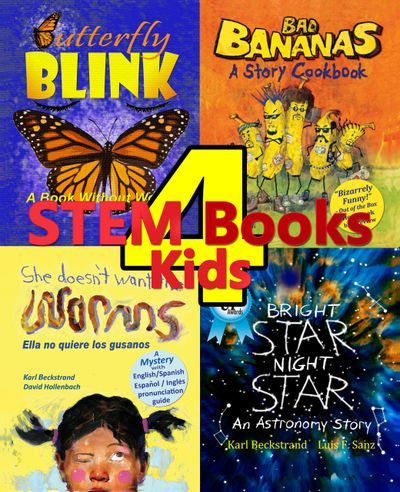
4 STEM Books for Kids: Science, Nature & Discovery
Includes:
• She Doesn’t Want the Worms / Ella no quiere los gusanos: A Mystery in English & Spanish
• Butterfly Blink: A Book Without Words
• Bad Bananas: A Story Cookbook for Kids
• Bright Star, Night Star: An Astronomy Story
This STEM collection introduces children to:
🪱 insect & animal biology
🦋 butterfly life cycles and change
🍌 food science and nutrition
⭐ astronomy and the night sky
Why these STEM books work
GROW: How We Get Food from Our Garden
A multicultural STEM picture book that introduces gardening, food systems, and environmental awareness through simple storytelling and visual learning.
STEM concepts
• botany and plant growth
• gardening and food production
• nutrition and healthy eating
• environmental observation
Why teachers use this book
• Reinforces science vocabulary naturally
• Supports sequencing and comprehension
• Connects STEM learning to everyday life
• Encourages hands-on garden activities
Vocabulary children can learn
garden, seed, harvest, plant, soil, water, food
👉 Related topic: Food, Cooking & Gardening Books for Kids
👉 Free teacher guides available for educators, parents, and homeschoolers (sign up below)
Big Black Seed: A Book with No Words
A wordless STEM picture book that encourages observation, sequencing, creativity, and oral language development through visual storytelling.
STEM concepts
• plant growth
• sequencing and observation
• prediction and scientific thinking
Why wordless STEM books are effective
• Remove reading barriers
• Encourage scientific observation
• Build speaking and comprehension skills
• Allow students to narrate and interpret independently
Why teachers and parents use wordless books
• Excellent for ESL and multilingual learners
• Encourages classroom discussion
• Supports mixed reading levels
• Develops vocabulary through conversation and context
👉 See also: Best Wordless Picture Books for Kids
👉 See also: Arriba Up, Abajo Down at the Boardwalk: A Picture Book of Opposites
The Bridge of the Golden Wood: A Parable on How to Earn a Living
Horse & Dog Adventures in Early California: Short Stories & Poems
STEM books help children develop:
• science vocabulary
• comprehension skills
• questioning and prediction
• observation and sequencing
• communication and discussion skills
Well-designed STEM stories encourage children to:
• ask questions
• notice patterns
• connect ideas
• explain observations
• participate actively in reading and discussion
Books that combine science with storytelling are especially effective because children remember vocabulary more easily when concepts are tied to engaging narratives and visuals.
Day 1: Read & Observe
• Read aloud together
• Identify STEM vocabulary
• Ask prediction questions
Day 2: Discuss & Explore
• Re-read key sections
• Discuss scientific ideas
• Compare observations
Day 3: Apply & Extend
• Draw diagrams or life cycles
• Retell the story
• Complete a simple STEM activity
These low-prep approaches work well for:
STEM read-aloud books help children:
• connect literacy with real-world science
• build confidence discussing scientific ideas
• retain new vocabulary through repetition
• participate regardless of reading level
Visual and story-based STEM books are especially effective for:
• beginning readers
• reluctant readers
• bilingual learners
• hands-on learners
What are the best STEM books for elementary students?
The best STEM books for elementary students combine engaging storytelling with science concepts such as nature, astronomy, gardening, animals, and food science. Books with visuals, repetition, and discussion opportunities are especially effective.
How can I teach STEM with literacy?
You can combine STEM and literacy by using science-themed read-alouds, vocabulary discussions, sequencing activities, and simple hands-on extensions connected to the story.
Are STEM picture books effective for ESL students?
Yes. STEM picture books with strong visuals, repetition, and contextual vocabulary help ESL and multilingual learners build comprehension and confidence.
How do wordless STEM books help children learn?
Wordless STEM books encourage children to observe, predict, describe, and narrate scientific ideas in their own words, helping develop both literacy and critical thinking skills.
Young children respond especially well to:
• animals and insects
• gardening and plants
• food and nutrition
• weather and space
• life cycles and observation
KidsWorldBooks titles feature multicultural characters, family-friendly themes, positive values, and human-created stories designed to support literacy, curiosity, and joyful learning.
📘 Related Reading Guides
👉 Browse ALL Kids’ Book Lists & Reading Guides (by Age, Level & Topic)
📘 Free Teacher Guides & Classroom Resources
✔ STEM + literacy integration
✔ Vocabulary and discussion prompts
✔ Bilingual-friendly activities
✔ Flexible classroom and homeschool use
👉 Sign up below for a free STEM & Literacy Mini-Unit Lesson Plan (K–5)
📘 Explore Related Book Categories
• Book Topics (STEM, Food, Career See also: Sports)
• Activity & Interactive Books
📘 Free Food-Themed Learning Activities
“Entertaining…gives children a lot of information.” - Mamta Madhavan for Readers’ Favorite (Grow)
“Delightful…humorous…bright” — School Library Journal (She Doesn’t Want the Worms)
“Bizarrely funny!” – The Horn Book (Bad Bananas)
About the Author
Books by Karl Beckstrand feature multicultural characters, humor, and educational themes that support literacy, STEM learning, bilingual education, and positive values.
These books are used by teachers, homeschool families, libraries, and ESL programs in the United States and internationally. See book awards.
Learn more about the author and classroom resources:
KidsWorldBooks About Page